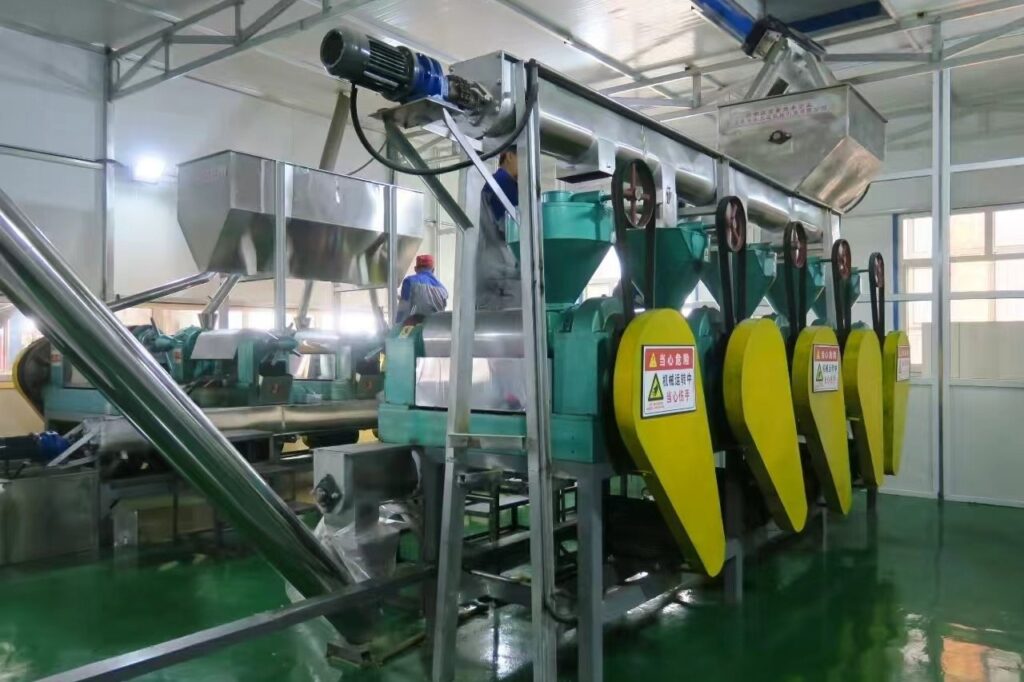
A screw oil press is usually the first machine a buyer specifies — and the one most often specified wrongly. The model that looks strongest on a specification sheet is not necessarily the one that fits your raw material, your throughput, or the machines sitting either side of it. This guide sets out the decisions in the order they actually matter.
1. Start from the material, not the catalogue
Screw presses are sold by material, because the same machine behaves differently on different oilseeds. Before you compare models, write down four things:
- The material. Soybean, rapeseed, peanut, cottonseed, sunflower seed, corn germ, sesame, copra or palm kernel — each presses differently.
- Cold or hot pressing. Cold pressing keeps the oil at low temperature and suits premium edible oil; hot pressing conditions the material first and generally releases more oil.
- The oil content of the material. High-oil material needs more torque and different screw geometry than low-oil material.
- The condition of the material on arrival. Whether it is clean, dry and uniform, or needs cleaning, cracking, flaking or cooking before it can be pressed at all.
A press sized for sunflower seed will not automatically suit copra or palm kernel. A supplier who quotes a model before asking what you are pressing is quoting a catalogue rather than a solution.
2. Size the press against the throughput you need, not the biggest number
Press capacity is quoted in kilograms of material per hour, and it is one of the few figures that is directly comparable between models. What matters is the throughput on your material, not the throughput on whatever material the brochure was written around.
| Model | Typical capacity | Power | Where it fits |
|---|---|---|---|
| 6YL-100 | 200 kg/h | 7.5 kW | Small workshops and pilot lines |
| 6YL-160 | 250–300 kg/h | 30 kW | The usual starting size for a commercial pressing line |
| 6YL-218 | 600–800 kg/h | 45 kW | Higher-volume lines and pre-pressing duty |
Two cautions. First, a rated figure is a ceiling under good conditions, not a promise for your material — ask the supplier to state the throughput for the seed you are actually pressing. Second, do not oversize for comfort. A press run well below its capacity gives you worse oil recovery per hour, more wear and a line that is harder to control. Size to your real target, then allow one step of headroom, not two.
3. Decide between single pressing and pre-pressing
There are two ways to get oil out of an oilseed, and the choice affects every machine you buy afterwards.
- Single pressing (full pressing). The screw press takes out as much oil as it can in one pass. Capital cost is lower and the line is simpler. It suits smaller capacities, higher-value specialty oils, and buyers who do not want to run a solvent plant.
- Pre-pressing followed by extraction. The press removes part of the oil and the cake goes on to solvent extraction. Recovery is higher, but the plant is far more complex and generally only makes sense at large scale.
Most buyers building a first line start with single pressing and then refine the crude oil they produce. If you expect to scale, it is worth specifying the pressing stage so that the press can later run as a pre-press. Our process solutions pages set out how the stages fit together.
4. Compare presses on the things that decide your running cost
Two presses with the same nominal capacity are not the same machine. Ask about:
- Wear parts. The screw shaft, pressing worm and cage bars wear first. Ask what material they are made of, whether hardened sections are used, what a replacement set costs and how long it lasts.
- Residual oil in the cake. This is the real measure of performance. It is material-dependent, so ask for a figure for your specific oilseed — and ask how that figure was measured.
- Drive and gearbox. A press is only as reliable as what turns it. Ask which gearbox is fitted and whether spares are available in your region.
- Temperature control. Hot pressing needs stable temperature control; without it, both oil quality and throughput drift.
- Spares and turnaround. A press standing idle for three weeks waiting for a part costs more than the part.
5. The press is only one machine in the line
The most common mistake is buying a press and then discovering it cannot be fed, or that the oil it produces cannot be sold. A working oil pressing line normally includes:
- Cleaning. A vibrating screen removes stones and plant matter; at this scale a 500–800 kg/h unit is typical.
- Conditioning. Heating and moisture control before the press.
- Pressing. The screw press itself.
- Filtration or settling. Crude oil carries foots that have to come out before it is stored.
- Conveying. Screw conveyors move material between stages; U-type screw conveyors are standard for seed and cake.
- Refining, if you are selling edible oil. Degumming, bleaching and deodorising turn crude pressed oil into a saleable product.
You can buy these machines one at a time, or buy a line that was designed as one system. Buying separately looks cheaper on paper and usually costs more in commissioning time, because nobody owns the interfaces between the machines. Every machine we supply is built to run inside the line it was specified for — see the equipment range for the machines that make up a complete pressing and refining line.
6. Questions to put to any supplier
- What throughput will this model achieve on my material?
- What residual oil should I expect in the cake, and how is that measured?
- Which parts wear, how often are they replaced, and what do they cost?
- What does the press need upstream and downstream in order to work?
- What is the installation and commissioning arrangement, and who pays for travel?
- What does the warranty cover in practice?
- Can you give me a reference project running on a similar material?
A supplier who can answer all seven without going away to check is worth talking to. A supplier who cannot answer the first two is not selling you a press; they are selling you a box.
7. Common mistakes
- Buying on capacity alone. Capacity tells you how fast a machine can run, not what it produces.
- Forgetting the auxiliary equipment. Cleaning, conveying and filtration are not optional extras — the line does not run without them.
- Ignoring the material. The same press on two different oilseeds behaves like two different machines.
- Buying the cheapest wear parts. Replacement screws are where a cheap press becomes an expensive one.
- Not planning for the oil you produce. Crude pressed oil still has to be filtered or refined before anyone buys it.
Frequently asked
How much oil does a screw press recover?
It depends on the oilseed, how the material was prepared, and how the press is set up and run. There is no single figure that applies across materials, so treat any supplier who quotes one number for all oilseeds with caution. Ask instead for the residual oil in the cake for your specific material, and ask how it was measured.
Can one press handle several different oilseeds?
Mechanically, often yes — but it will not perform equally on all of them, and switching material normally means changing settings and sometimes parts. If you intend to press more than one oilseed, say so when you specify the machine, so that the supplier configures it for the range you actually intend to run.
How long does installation take?
It depends on the size of the line and how much site work the buyer does. A single press and its auxiliary machines is a short installation; a complete pressing and refining line takes considerably longer, and needs foundations, power and water in place first. Ask for the commissioning plan in writing before you order, not after the crates arrive.
Do I need refining equipment as well as a press?
Only if you intend to sell edible oil. Pressing produces crude oil, which still carries foots, gums and odour compounds. If your buyer accepts crude oil, filtration may be enough; if you are packaging edible oil, you will need degumming, bleaching and deodorising as well.
Tell us what you are pressing
Send us the oilseed or fat you will process, the throughput you are targeting, and the finished product you want to sell. Our engineers will come back with the press model, the machines that go either side of it, and a plant layout. If you already know which model you need, the equipment range lists the presses and the auxiliary machines we build.
Request a quote — or message us on WhatsApp and we will reply with a configuration for your material.