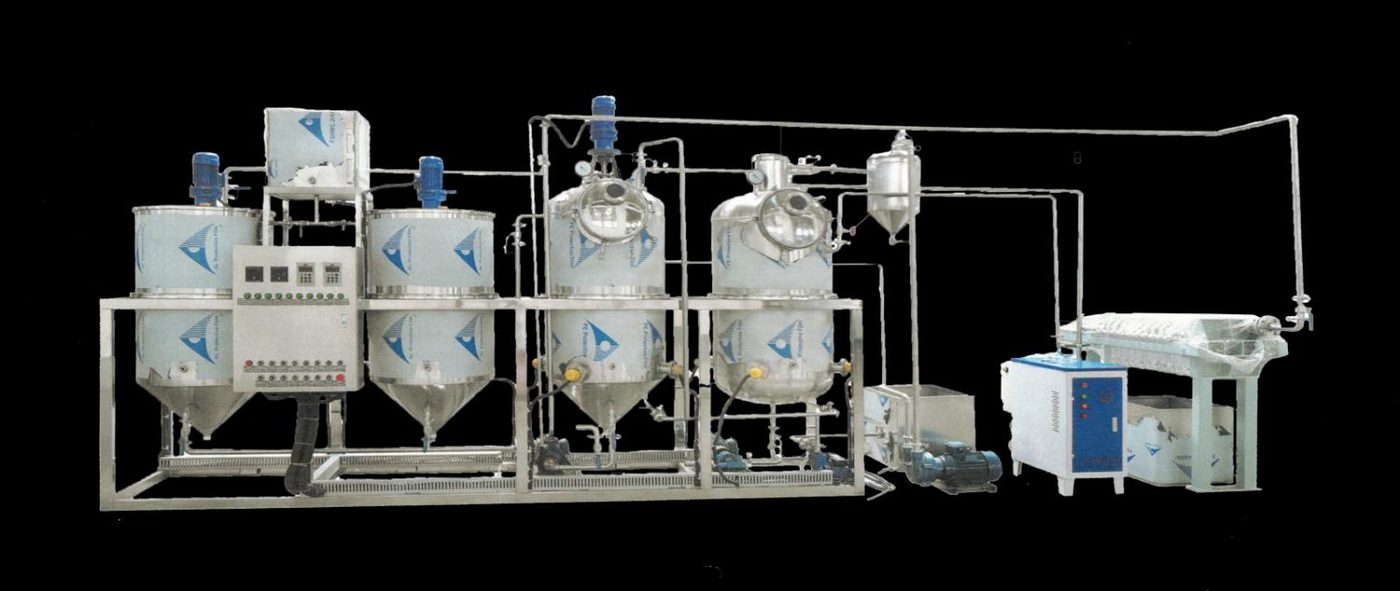
A press produces crude oil. Nobody’s kitchen and no food manufacturer buys crude oil. Between the press and a saleable product sits refining, and for most small and mid-size plants refining means three stages: degumming, bleaching and deodorising.
Each stage removes a different class of impurity, and each one has a failure mode that shows up in the finished product rather than in the plant. This is what they do, why the order matters, and where plants usually go wrong.
What refining is actually removing
Crude pressed oil carries a predictable set of unwanted material:
- Gums (phospholipids). Naturally present in pressed oil. They settle, they darken on heating and they make oil cloudy.
- Pigments. Chlorophyll, carotenoids and oxidation products that give the oil its colour.
- Free fatty acids. Formed by hydrolysis of the oil, and they affect taste, smell and shelf life.
- Odour and volatile compounds. What makes crude oil smell like a factory rather than a food.
- Trace metals, soaps, moisture and fine solids. Small quantities that promote oxidation out of all proportion to their size.
Refining is not one operation that removes all of these. It is a sequence, because each stage’s chemistry works on a different target and because the stages interact.
Degumming: removing the phospholipids
Gums are the first thing to go, and they go first for a practical reason: if they are not removed, they interfere with everything downstream. They consume bleaching clay, they foul deodorisers, and they settle out in storage tanks to form a layer that has to be scraped out by hand.
Water degumming works on a simple principle — gums are attracted to water, so water is dispersed into the heated oil, the gums hydrate and swell, and they are separated out. For oils with harder-to-remove gums, an acid degumming step is used as well, which converts the non-hydratable gums into a form that can be separated.
What good looks like: oil that stays clear, does not throw a deposit in the storage tank, and behaves predictably in the bleaching stage.
Bleaching: removing colour and the things that colour follows
Bleaching is not only about colour. Bleaching clay also adsorbs trace metals, residual soaps, oxidation products and the last of the gums, all of which would otherwise shorten shelf life or poison the deodoriser’s heat transfer.
The oil is mixed with an adsorbent under vacuum and heat, held long enough for adsorption to take place, and then the clay is filtered out. Two practical points decide whether it works:
- Dosing. Too little clay leaves colour and metals in the oil; too much strips out tocopherols and other useful minor components along with the impurities, and costs money on every batch.
- Filtration and clay handling. The spent clay is a waste stream with its own handling and disposal requirements, and it retains oil — the efficiency of the filtration step affects your yield directly.
Deodorising: the stage that makes oil taste like oil
Deodorising removes the volatile compounds responsible for odour and taste, and strips free fatty acids along with them. It works by passing steam through oil under deep vacuum and at elevated temperature, so that volatiles are carried off rather than cooked in.
Three things make it work, and all three are engineering decisions rather than operator preferences:
- Vacuum. Low pressure lets the process run at a temperature that removes volatiles without damaging the oil. Inadequate vacuum means higher temperature, which means darker oil and more trans-isomer formation.
- Steam quality and distribution. Steam has to contact the whole oil volume, not channel through it. Poor distribution looks fine on the gauge and fails in the bottle.
- Residence time and temperature control. Long enough and hot enough to strip volatiles; not so long or so hot that the oil degrades. Heat bleaching happens here too — the oil gets lighter in colour during deodorising.
Optional stages you may or may not need
Degumming, bleaching and deodorising are the core. Depending on your oil and your market you may also need:
- Neutralisation — removing free fatty acids by chemical means where the oil’s free fatty acid content is high, or where you prefer chemical refining.
- Dewaxing and winterisation — for oils such as sunflower and corn that throw a wax haze at low temperature. Without it, the oil looks fine at 25 °C and clouds in a cold store.
- Water washing and drying — where chemical refining has introduced soap that has to be washed out.
Whether you need them depends on the feedstock and on the specification your buyer tests against. Ask the buyer for the specification before you specify the plant, not after.
Chemical versus physical refining
There are two conventional routes. Chemical refining uses alkali to neutralise free fatty acids, producing soapstock as a by-product; physical refining removes free fatty acids in the deodoriser instead, which suits oils with low gum content and produces less waste. The choice changes the equipment list, the yields and the waste streams, and it is properly a decision to take with the plant supplier against your specific oil.
Where small refineries go wrong
- Undersized degumming. Gums passed downstream plug the clay and foul the deodoriser, and the plant owner then blames the deodoriser.
- Treating bleaching as a colour adjustment. Under-dosing clay to save money leaves trace metals in the oil, which oxidise it in storage.
- Weak vacuum. The most common single cause of dark, burnt-tasting “refined” oil from a small plant.
- No filtration discipline after bleaching. Clay carried into the deodoriser is a maintenance problem that compounds every batch.
- Refining without a specification to hit. Refining to “looks clean” rather than to the buyer’s tested parameters wastes yield and still fails the sale.
Equipment
Our small oil refining unit is built around these three stages for plants that press their own oil, and the equipment range covers the refining vessels, tanks and auxiliary machines around it.
Frequently asked
Can I sell crude oil without refining?
Some buyers will take crude oil, particularly for industrial use, but the price is lower and the buyer pool is much narrower. If you want to sell edible oil or supply food manufacturers, refining is not optional.
Can I skip bleaching?
Only if your oil is already light in colour and low in trace metals, and your buyer does not test for what bleaching removes. For most pressed oils this is not the case, and the consequences of skipping it appear weeks later as oxidation rather than immediately as colour.
How many stages does a small refinery need?
Degumming, bleaching and deodorising cover most pressed vegetable oils. Neutralisation, dewaxing and winterisation are added when the feedstock or the buyer’s specification demands them. The right way to decide is to start from the specification, not from a standard equipment list.
Key points to take away
- Refining is a sequence, not a step. Each stage targets a different impurity, and skipping one moves the problem downstream rather than removing it.
- Degumming comes first for a reason. Gums foul the clay, poison the deodoriser and settle out in storage. A plant that under-treats gums will look like a plant with a deodoriser problem.
- Bleaching removes more than colour. Trace metals and residual soaps are what it is really protecting you from, and under-dosing clay to save money costs shelf life.
- Vacuum is the difference between refined oil and cooked oil. Weak vacuum means higher temperature, darker colour and a burnt note that no amount of downstream work removes.
- Refine to a tested specification, not to an appearance. Ask the buyer what they measure, and design the plant to meet it with margin.
- Neutralisation and dewaxing are feedstock decisions. They are not upgrades to add later by preference — they follow from the oil you refine and the market you sell into.
Most of these are specification decisions taken before the equipment is ordered. Getting them right costs nothing extra at that stage and is expensive afterwards.
Match the plant to the specification
Tell us the oil you are pressing, the volume per day and the specification your buyer tests, and we will tell you which stages you need and how they should be sized. Request a quote.