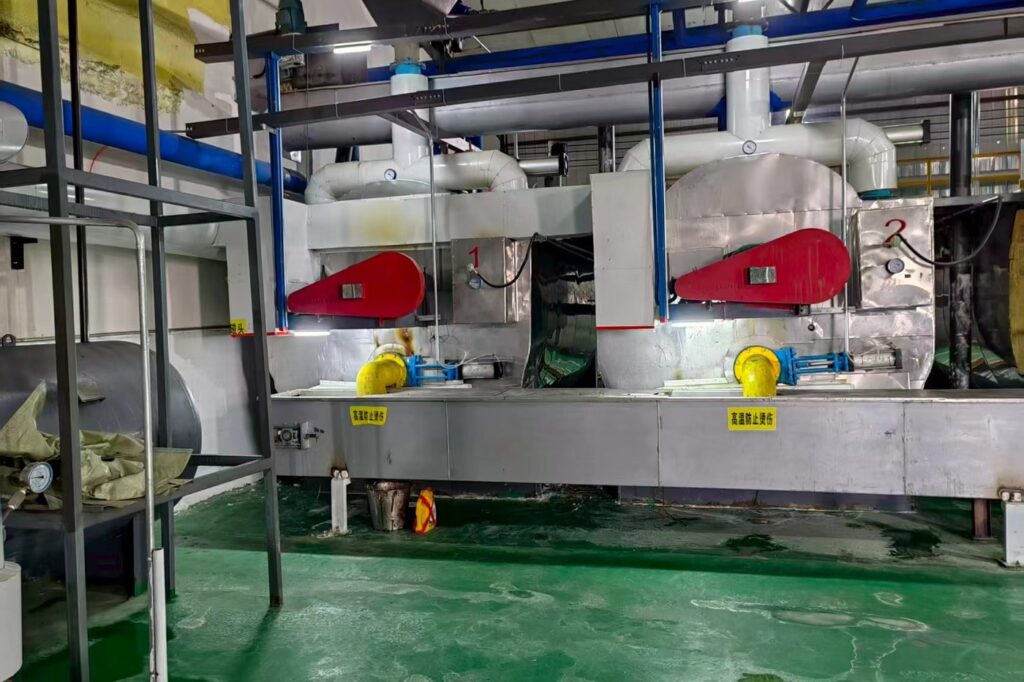
Rendering is the process of separating fat from the tissue, bone and water that surrounds it. It sounds simple and it is chemically simple — you are applying heat to make fat run out, then separating it — but almost every quality problem in a rendering plant traces back to how one of those steps was designed.
This is what actually happens in a rendering line, stage by stage, and where the engineering decisions sit.
What goes in
Rendering plants take a wide range of raw material, and the plant has to be designed around the mix you expect:
- Pig fat — back fat, intestinal fat and trimmings.
- Beef tallow — fat trimmings, bones with attached fat, and slaughter by-products.
- Poultry fat — often wetter and softer than mammalian fat, which changes both cooking and separation.
- Animal by-products — the trimmings and offal that are not sold as meat, from which fat is recovered and the solids become meal.
Two things vary enormously between these materials and drive the design: how much fat they contain, and how much water they bring with them. High-water material costs you energy before it earns you a single kilogram of fat.
Stage 1: size reduction
Fat is held inside cells and bound up in connective tissue. Cooking works from the outside in, so the smaller and more uniform the pieces, the faster and more completely the fat is released. A double-shaft shredder or similar size-reduction machine is usually the first machine in the line.
This stage is often skimped on and then blamed on the cooker. If the plant cannot reach temperature quickly, or the solids come out still fatty, oversized and uneven feed is one of the first things to check.
Stage 2: cooking — and the choice that matters most
Cooking breaks the cell structure and lowers the viscosity of the fat so it can drain and be separated. There are two established approaches:
- Dry rendering. The material is cooked in its own moisture, in batch vessels or continuous cookers. Free fat drains away and is collected; the remaining solids are pressed or centrifuged. It is the workhorse approach for high throughput.
- Wet rendering. Water or steam is added, fat rises to the surface and is drawn off. Wet rendering run at lower temperature is the route to higher-grade edible fats, because the fat is exposed to less heat and oxidises less.
Within those, vacuum rendering is the refinement that matters for edible product: cooking under reduced pressure lowers the boiling point so the material can be processed at a lower temperature, which protects colour, flavour and stability. It also removes moisture and odour compounds while cooking, which is why vacuum lines produce a noticeably cleaner fat.
We build both vessel-type and paddle-type rendering cookers, electrically heated, covering roughly 75–1500 kg/h depending on model — see the animal fat rendering plant page for the configuration we recommend for each material.
Stage 3: separating fat from solids
After cooking, the batch is not “fat and waste” — it is fat, water, fine solids and coarse solids all together, and each has to be separated from the others:
- Draining. Free fat is drained off the cooker as the first, cleanest stream.
- Pressing or centrifuging. The remaining solids still hold fat. A screw press or a decanter centrifuge recovers it. A decanter gives continuous separation of solids from liquid, which is what makes continuous lines possible.
- Polishing. The recovered fat still carries water and fine solids. Settling tanks, heating and further separation clean it up before storage or refining.
Get this stage wrong and you lose fat in two directions at once: left in the solids leaving the plant, and left as sludge in the tanks.
Stage 4: drying and finishing the solids
The de-fatted solids are not waste. They are dried, and depending on the material they are ground and screened into meat and bone meal. That line is a plant in its own right — bone crushing, cooking and degreasing, drying, grinding and screening — see meat and bone meal processing. Moisture content and particle size both affect the value of the finished meal, so the drying and grinding stages need the same attention as the fat side of the plant.
Fat quality: what actually decides the grade
Fat is graded on a small number of measurable properties, and they are all influenced by the process rather than by the raw material alone:
- Free fatty acid content. Rises with time, temperature and moisture. Fast processing at lower temperature keeps it down.
- Moisture and impurities. Residual water drives hydrolysis and rancidity. Good separation and drying are the fix.
- Colour and odour. Largely a function of heat exposure and oxidation — the reason vacuum and low-temperature wet rendering exist.
Edible-grade fat needs a line designed for it from the start: controlled-temperature rendering, careful separation, and refining and dehydration afterwards. Technical-grade fat can be produced on a simpler plant, but you cannot upgrade a technical line into an edible one simply by running it more slowly. For the edible route see edible lard rendering.
Where rendering plants go wrong
Most underperforming rendering plants fail in the same handful of places. If you are specifying a new line or troubleshooting an existing one, these are worth checking in order.
- Undersized separation. The cooker gets all the attention and the decanter or press gets whatever budget is left. But separation is where fat is actually recovered, and a plant with slow separation backs up the cooker and loses fat into the solids. If fat in the meal is high, the press or centrifuge is the first suspect.
- Inadequate drying of the solids. Meal leaving the plant too wet loses value, clogs grinding equipment and can go mouldy in storage. The drying stage has to match the cooker’s output, not just be present.
- Heat supplied on paper only. The steam boiler or electrical supply is treated as an external matter and turns out to be marginal. A render cooker that cannot reach and hold its temperature produces lower-grade fat and a wetter meal, on every batch.
- Water carried through the whole line. Water is heat you paid for and then have to remove again. Draining free water early, and keeping material out of the rain, is free capacity.
- No temperature discipline. Running hotter to go faster raises free fatty acid content, darkens the fat and reduces its grade. For edible product this single habit can cost more than the equipment it was meant to speed up.
- Material mix drifting from the specification. A line designed around beef trimmings and fed poultry offal will separate differently, dry differently and produce a different grade of fat.
None of these are exotic failure modes. They are all specification and operating decisions, which is why it matters to describe your material and your target grade before the equipment is chosen rather than after it is installed.
What the line looks like end to end
Size reduction, cooking, fat separation, fat polishing, solids drying and grinding, with conveying and steam supply tying it together — an industrial steam boiler normally provides the heat, and screw conveyors move material between stages.
Tell us the material, the volumes and whether you are targeting edible or technical grade, and we will propose the configuration. Request a quote, or start with the equipment range.