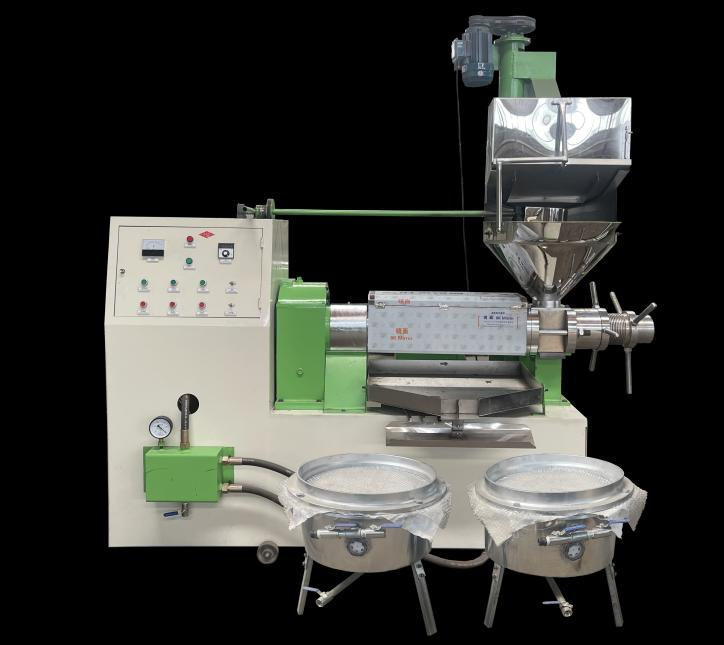
Most disagreements about oil press sizing come down to people measuring different things. One buyer means kilograms of seed going in; another means litres of oil coming out; a third means tonnes per day. Until everyone is measuring the same quantity, the numbers cannot be compared — and a press that looked correct on paper turns out to be the wrong size on site.
This is how to work out the capacity you actually need, in the order the arithmetic has to be done.
1. Decide what you are counting
Three different numbers get called “capacity”, and they move in different directions:
- Seed throughput. Kilograms of raw material pushed through the press per hour. This is the number press manufacturers quote, and it is the only one you can compare like for like.
- Oil output. How much oil you get out. It depends on the oil content of the seed, the preparation, and how the press is set — so it is always lower than the throughput number, never equal to it.
- Cake output. What is left after pressing. In most plants the cake is a saleable product, not waste, and its quantity matters as much as the oil.
Write down which of the three your business actually depends on. If you are paid for oil, size on oil; if you are selling cake or meal to a feed buyer, the cake volume constrains you just as hard.
2. Convert between kg/h and tonnes per day properly
Manufacturers quote kg per hour. Project plans are written in tonnes per day. The conversion is trivial — but only if you use the hours the plant really runs.
The mistake is assuming 24 hours. A single-shift operation runs eight. Even a three-shift plant loses time to cleaning, die changes, maintenance and start-up. A realistic working figure for a well-run plant is the scheduled shift hours minus allowances, not the clock on the wall.
- 8-hour shift → multiply kg/h by 8
- Two 8-hour shifts → multiply by 16
- Three shifts with allowances → treat it as roughly 20–22 working hours, not 24
An 800 kg/h press is not “19 tonnes a day”. On one shift it is about 6.4 tonnes, and the difference between those two numbers is the difference between buying one press and buying three.
3. Work back from the throughput you need
Once you know the shift pattern, the calculation is one line:
Required press capacity (kg/h) = target material per shift (kg) ÷ working hours per shift
Worked example. You want to process 6 tonnes of seed in one 8-hour shift. That is 6,000 kg ÷ 8 h = 750 kg/h of material through the press. Looking at a range with rated capacities of 200 kg/h, 250–300 kg/h and 600–800 kg/h, the answer is the largest model — a single 6YL-218, which covers 600–800 kg/h. The 6YL-160 at 250–300 kg/h would need three units running in parallel to reach the same figure, which usually costs more in floor space, wiring and labour than one larger press.
If you need 20 tonnes a day over two shifts, the arithmetic gives 20,000 kg ÷ 16 h = 1,250 kg/h — two 6YL-218 units, and a plant layout that can feed both.
Note what the arithmetic does not include: the rated figure is a ceiling under good conditions on a favourable material. Ask the supplier for the throughput on the seed you will actually be pressing before you commit to a number. See the press models we build for the capacities we quote.
4. Size the line, not just the press
A press running at its own capacity is useless if the machines either side of it cannot keep up. The usual chain is cleaning, conditioning, pressing, then filtration or conveying — and every stage has its own throughput figure.
- Cleaning. A vibrating screen in this class runs at roughly 500–800 kg/h. A single unit covers a press of similar throughput; a two-press line normally needs two, or a wider screen.
- Conveying. Screw conveyors have to move the cake volume as well as the seed, and cake behaves differently from seed. Size the conveyor on the harder material, not the easier one.
- Filtration and storage. Crude oil arrives carrying foots, and the settling or filtration stage sets how fast you can empty the press’s oil outlet. If it backs up, the press slows with it.
The practical rule: find the slowest machine in the chain, because that is the capacity of your plant. Buy the line as one specification rather than a set of unrelated machines — the auxiliary equipment has to be matched to the press, not chosen after it.
5. Common sizing mistakes
- Using 24 hours a day. Nobody runs 24 productive hours. The plant that does not stop does not maintain itself either.
- Treating the nameplate as a guarantee. Rated capacity assumes prepared material and a correctly set press. Ask for the figure on your material.
- Sizing for the best day, not the average day. Harvest arrivals are lumpy. Some headroom is worth paying for; a plant that cannot clear its intake in season loses material.
- Oversizing for safety. A press run far below capacity recovers less oil per hour and wears faster than one run near its design point. One step of headroom is sensible; two is expensive.
- Forgetting the oil, not just the seed. If your target is a daily volume of finished oil, convert that target back through the oil content — the seed tonnage you need is always larger than the oil tonnage you want.
How oil content changes the arithmetic
There is one more step that catches buyers out: the gap between how much seed you process and how much oil you produce. Those two numbers are never the same, because a large part of every oilseed is not oil — it is meal, hull and moisture, and it all has to pass through the press.
Oil content varies widely between oilseeds, and it also varies within one species depending on variety, growing conditions and how dry the material was at intake. So the same press running the same throughput can give you very different daily oil volumes depending on what you feed it. Do the calculation in whichever direction your business actually works:
- Sizing on seed. You know how much material you can buy, store or harvest. Size the press on that tonnage and accept whatever oil volume follows.
- Sizing on oil. You have a contract or a target volume. Divide the oil you need by the oil content of your material to get the seed tonnage you must process, then divide by working hours to get kg/h.
The second direction is the one that surprises people. A target that sounds modest in litres of oil can demand considerably more seed tonnage than expected, because the press is handling the whole seed, not only the oil inside it. Three practical consequences:
- Ask for the oil content of the actual material you will buy, not the textbook value for the species.
- Re-run the sizing if you change supplier or origin. A different oil content is a different plant requirement.
- Plan storage for the cake as well as the oil. In most oilseeds the cake stream is the bulkier of the two.
And remember that no press extracts every drop. A proportion of the oil stays in the cake, and how much depends on the material, the preparation and the press settings. Treat a rated capacity as a throughput figure for the press, and treat the oil output as a separate, lower number to be confirmed for your specific case before you sign anything.
Get the number checked
Send us the material, the working hours and the output you are targeting, and we will come back with a press model and the machines that go either side of it. If you tell us the seed and the shift pattern, the sizing is straightforward arithmetic — and it is much cheaper to do it here than after the equipment has been delivered. Request a quote, or look through the equipment range first.